Showing posts with label lims. Show all posts

Friday, February 18, 2011

SLM (Sample Lifecycle Manager)

SLM

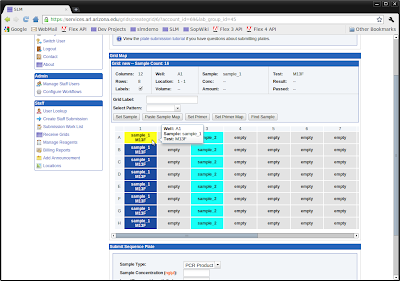
We released the latest version of SLM (Sample Lifecycle Manager) on February 1st, and the site has been a resounding success so far. SLM supports life sciences laboratory services offered by UAGC including:
  • DNA extraction
  • Sanger sequencing
  • DNA fragment analysis (str/microsatellite)
  • Sequenom genotyping
  • Sequenom methylation analysis
  • Taqman genotyping
  • 454 sequencing
  • Ion Torrent sequencing (coming soon)

EAGER

SLM is built with Eager, an application framework for developing custom LIMS. Eager is a collection of Django apps that provide common LIMS functionality including:
  • Workflow management with GLP compliant status logging
  • GLP compliant user and lab access control and management
  • Sample/tube/grid submission and management
  • Volume and concentration tracking
  • Automated sample and reagent dilution and 'cherry picking' transfers
  • Reagent lot tracking
  • Data management and collaboration
  • Integration with SOP management system
  • Environmental monitoring
The core features of Eager can be used 'out-of-the-box' for a complete LIMS solution with a generic sample tracking workflow, or can be customized to provide service specific workflows (such as Sequenom, 454, Ion Torrent, etc.) The framework includes tons of features, and additional workflows can be easily added by an experienced Django developer. Custom workflows are simply custom Django apps that hook into Eager's workflow definition system. All client-side code is written with the Dojo framework.

I am hoping to release the Eager framework on GitHub this spring or summer (it will be the first "open-source LIMS that doesn't suck"), but it currently needs to be reviewed by our IP/legal department first.

Thursday, February 19, 2009

Plater Released!

I released Plater 0.1 today.

Plater is a Python package that contains common LIMS classes that can be used to build a custom LIMS application.

Instead of starting your LIMS application from scratch, use the Plater package to represent common LIMS domain models, and piece them together in whatever configuration your application requires.

Take a look at the Plater project page for details on how to download/install/use Plater.

Sunday, September 21, 2008

Using PyAMF and SQLAlchemy together

This past week I recieved the go-ahead to re-code the backend of our LIMS application with Python (it's currently PHP). It's not a minute too late, as I don't think I can stand typing another '->' or '$' without throwing something at the wall. I could go on about why I'm really sick of PHP and why Python rocks, but I'm sure you can read all about that elsewhere.

We'll be using Python's SQLAlchemy ORM, which kicks some serious ass. SQLAlchemy makes it amazingly simple to model complex relationships like inheritance hierarchies and many-to-many relationships that I could only implement with gobs of gnarly custom code in PHP.

Since we're already re-writing the backend we decided that we may as well tweak the Flex client at the same time. We are going to be making the switch from JSON to AMF for server-client communication, which will be more performant and allow us to transfer richer objects back and forth.

Python is pretty awesome for web-development, but the project that aims to support AMF (PyAmf) is still new and immature (but it does encode and decode as advertised and is under active development). In fact, the current stable release of PyAmf will not properly encode objects that are being managed by SQLAlchemy. There is a SQLAlchemy 'adapter' in the development branch of the PyAmf project that can be used, but I found the code to be lacking.

I decided to take matters into my own hands, and I am currently working on my own SQLAlchemy adapter that will hopefully work a little better. The code for my SQLAlchemy adapter can be found on Google code. It is not production ready, but if you want to experiment with it (tested only with SA 0.5), you should be able to drop it in the 'adapters' directory of the PyAmf 4.* branch to use it.

The adapter has 2 main features. It overrides the pyamf.util.get_attrs function so that the pyamf encoder skips any attributes of an object that are used by SQLAlchemy (_sa_instance_state, _sa_manager, etc), and it also identifies and translates SQLAlchemy collection objects, such as InstrumentedList objects.
Saturday, August 23, 2008

Lims Coder

I'm starting this blog to discuss my experiences with the development of web-based LIMS. I'm drawing most of my content from experience developing applications for a university biotechnology core facility.

The topics will include server-side design, client-side design, lab equipment issues, code examples, and anything generally related to web-application development for life-sciences laboratories.